
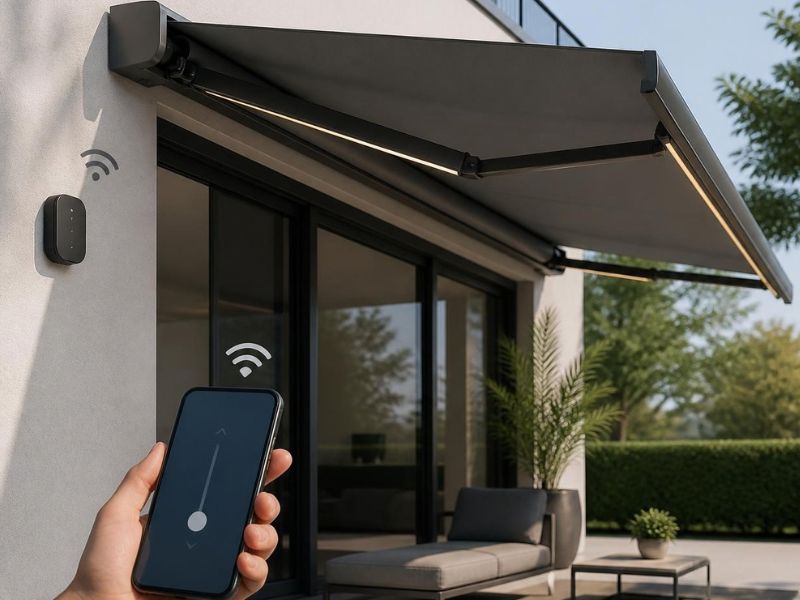
Awnings no longer have to be opened and closed manually every time. Technology makes it possible to automate many of their functions and make them better suited to how each space is used. There are different smart systems for awnings that allow you to control their operation easily and, in some cases, even without having to keep an eye on them.
Why opt for smart systems for awnings?
One of the main advantages of automating an awning is convenience. Instead of using a crank to open or close it, it can be controlled electrically. Depending on the system installed, this can be done using a switch, a remote control, a mobile application or even a voice assistant.
In addition, automation allows the awning to respond to certain conditions. For example, if it is very windy, it can retract automatically. Likewise, some systems allow you to make the most of the awning when there is a lot of sunlight without having to keep opening and closing it throughout the day.
It is also possible to set schedules or different operating modes. This is practical both in homes and on terraces, patios or in businesses, as it allows the awning to be adapted to the needs of each space and used more comfortably.
Different smart systems for awnings
There are different ways to automate an awning, and not every installation needs the same functions. The choice depends on the type of awning, the space and what you want to achieve:
1. Electric motorisation to open and close the awning
Motorisation is one of the most basic systems for automating an awning. The motor is responsible for carrying out the opening and closing movement, so there is no longer any need to use a crank. Depending on the model, the motor can be controlled from a switch or by using a remote control. It is a simple option for those who want greater convenience when using the awning on a daily basis.
Before installing it, it is necessary to take into account the characteristics of the awning, such as its size, weight and opening system. This makes it possible to choose suitable motorisation.
2. Remote control to operate the awning
The remote control allows you to open, close or stop the awning without having to approach it. It is a practical alternative for terraces or areas where the awning is installed at a certain height or in a difficult-to-reach location.
In addition, some systems allow you to control several awnings from the same remote control. This makes their use even easier when there are several installations in a home or business.
3. Wind sensors
Wind is one of the factors that should be taken most into account when an awning is installed outdoors. With a wind sensor, the system can detect when conditions are too strong and order the awning to retract.
This means that it is not necessary to keep an eye on the weather forecast or the conditions at the time to decide when to close it. This function can be especially useful when there is no one at home or at the establishment.
4. Sun sensors
Sun sensors allow the awning to respond to the intensity of the light. When a certain level of sunlight is reached, the system can extend the awning to provide shade.
In this way, you can make better use of sun protection without having to constantly control the awning. It can also help reduce direct sunlight entering the home.
5. Rain sensors
There are also systems that incorporate sensors capable of detecting rain. When it starts to rain, the awning can retract automatically, depending on the selected configuration.
This option can be combined with other sensors so that the system takes different weather conditions into account and responds in a specific way.
6. Schedule programming
Another possibility is to schedule the operation of the awning according to specific times. For example, it can be set to open or close at certain times of the day.
It is also possible to create different scenarios so that several awnings operate at the same time or to adapt their operation to different moments. This makes it possible to automate tasks that would otherwise have to be carried out manually every day.
7. Mobile control
Some systems allow you to operate awnings from a mobile phone or tablet. Through an application, it is possible to send commands to open or close them and, depending on the installation, configure schedules and different automations.
One of the advantages of this option is that control does not necessarily have to be carried out from the place where the awning is installed. With systems that allow remote control, it can be managed from a mobile phone even when you are not at home.
8. Integration with home automation and voice assistants
Awnings can also form part of a home automation system. This makes it possible to connect them with other smart devices in the home and control different elements from the same system.
In some installations, it is also possible to use voice assistants to open or close the awnings using a command. In this way, the awning can be integrated into the usual routines of a smart home.
Opt for smart awnings on the Costa del Sol
At Toldo Express, we work with awnings, pergolas and mobile roofs to adapt each installation to the characteristics of the space and the needs of each customer. We are a family-run company and offer different installation and automation options, working with specialised suppliers.
We offer our services for awnings in Malaga, Marbella and Estepona, both for homes and businesses. We advise on the different options available and look for a practical and convenient solution for each space. Contact us.